
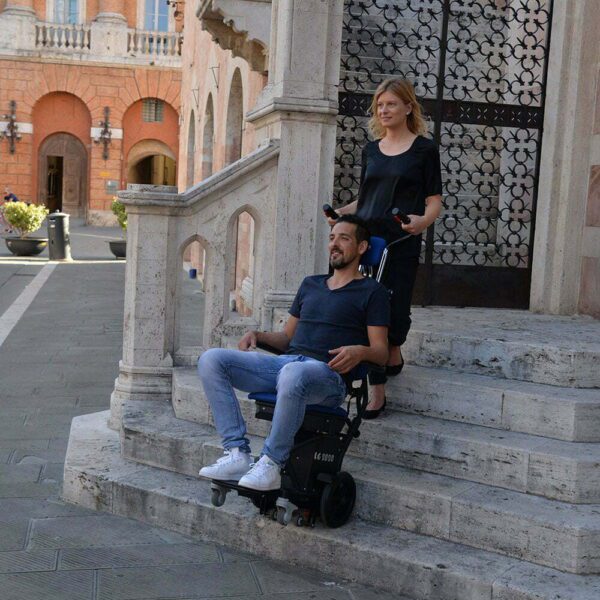
Stairs can be a significant obstacle for people who use wheelchairs. When a building does not have an elevator or a suitable ramp, a stair climber for people with disabilities may provide a practical solution. This portable device helps users safely navigate changes in floor levels.
What is a stair climber and how does it help people with disabilities?
A stair climber is a mobility device designed to help people with limited mobility travel up and down stairs. Depending on its design, it can be used with a wheelchair or feature its own built-in seat, onto which the user must transfer before use.
Modern models may be equipped with an electric drive, reducing the physical effort required from the caregiver, who no longer needs to manually lift the combined weight of the wheelchair and its user. However, this does not generally mean that a wheelchair user can operate the stair climber completely independently. Proper training and adherence to safety guidelines are essential when using the device.
Types of stair climbers
The two main types of stair climbers are tracked stair climbers and crawler-style stair climbers. Their design determines the types of staircases they can be used on.
Tracked stair climbers are particularly well suited to straight flights of stairs. Their tracks provide a large contact area with the steps, helping to maintain the stability of the device during operation.
Crawler-style stair climbers use a different mechanism to navigate steps. They can be useful in buildings with narrower or less conventional staircases. However, their suitability also depends on the specific model and the conditions of the staircase.
There is no single stair climber suitable for every type of staircase. Before purchasing, it is therefore essential to check the device’s specifications and ensure that it is compatible with the environment in which it will be used.
When to consider using a stair climber?
A stair climber for people with disabilities can be particularly useful in buildings without an elevator, ramp or other accessible solution for navigating stairs.
It can be a practical solution for:
- houses or apartments located on upper floors,
- public buildings,
- medical centres, clinics and other healthcare facilities,
- schools and institutions,
- travelling to places where stairs need to be navigated
One of the main advantages of a stair climber is its portability. The device can be moved between rooms, and some models can also be transported by car. This eliminates the need to install a permanent structure in every location where stairs may present an accessibility challenge.
Stair climbers and user safety
Navigating stairs always requires caution. A stair climber does not eliminate the risks associated with transporting a person up or down stairs. For this reason, both the user and the caregiver should be familiar with the operating instructions and safety guidelines for the specific device.
Before using the device, make sure to check:
- proper securing of the wheelchair or user,
- the overall technical condition of the device,
- the battery charge level in electric models,
- the width and design of the staircase,
- the amount of available space on landings,
- the maximum combined weight of the user and wheelchair specified by the manufacturer.
It is also important to practise operating the device beforehand. Taking advantage of training or guidance provided by the seller or manufacturer is particularly recommended before using the stair climber for the first time.
Can a stair climber replace an elevator?
A stair climber is a portable mobility solution, but it should not be considered a universal replacement for an elevator or a permanently installed platform lift. It requires assistance from another person, and its suitability depends on the type of staircase and compatibility with the wheelchair. In some buildings, permanent accessibility solutions may be a better option, providing convenient access for all users.
For this reason, it is best to carefully assess the intended place of use and the individual needs of the person before purchasing a stair climber. When properly selected, this type of equipment can make getting around significantly easier in places where navigating stairs without additional assistance is extremely difficult or even impossible.