
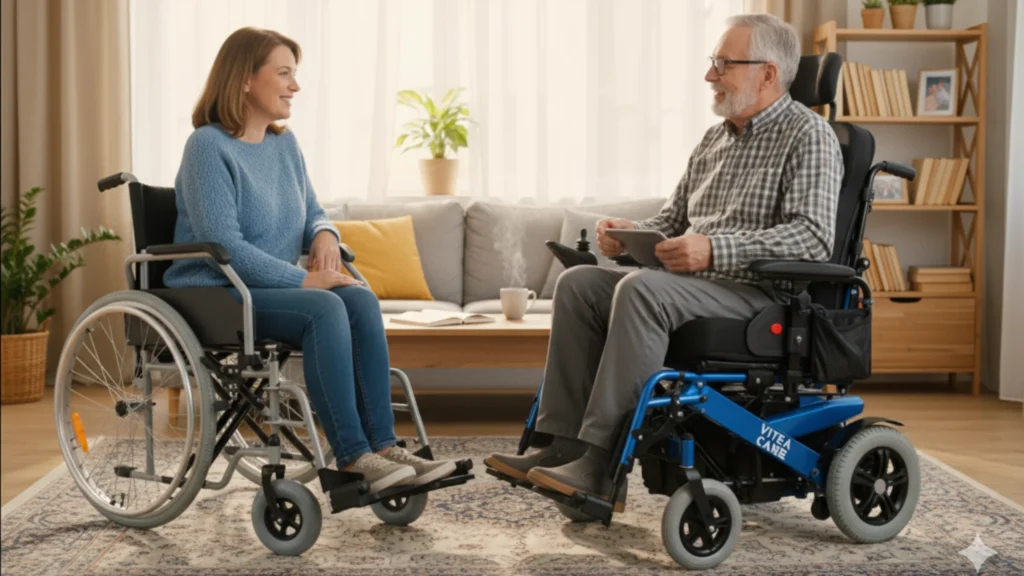
Choosing the right wheelchair is an important decision that can significantly affect quality of life, independence and everyday mobility. One of the key questions many users face is whether to choose a power assist device for an active wheelchair or a fully powered wheelchair.Both solutions offer greater freedom and mobility, but they differ in functionality, ease of use and cost. The right choice depends on lifestyle, physical abilities and individual needs.
What Is the Difference?
Both power assist devices for active wheelchairs and fully powered wheelchairs are designed to make mobility easier and increase user independence. However, they differ in design, operation and the level of assistance they provide. A power assist device is an add-on to a manual wheelchair, while a powered wheelchair is a fully integrated mobility solution with its own motor and control system.


Advantages and Limitations: Power Assist vs. Powered Wheelchairs
Add-on Power Assist / Power Attachment

Advantages:
- Flexibility: Can be attached to an existing wheelchair, provided it is compatible.
- Cost: Generally less expensive than purchasing a new powered wheelchair.
- Lightweight options: Some power assist modules weigh approximately 5 kg, making them easier to transport.
- Maintenance: Often simpler and less expensive to service than fully powered wheelchairs.
- Hybrid functionality: Some solutions allow users to switch between electric assistance and manual propulsion without changing wheelchairs.
Limitations:
- Additional weight: Heavier modules can make wheelchair transport and handling more difficult.
- Stability and handling: Performance depends on the type and quality of the attachment.
- Some models may be less suitable for challenging terrain.
- Range and speed: Battery capacity determines the range, typically from several to several dozen kilometres.Operating speeds generally range from a few km/h up to approximately 10–12 km/h.
- Installation and compatibility: Not every manual wheelchair is compatible with every power assist attachment.
Power wheelchair

Advantages:
- Comfort and independence: Full joystick control without the need for manual propulsion.
- Functionality: A wide range of models offering adjustable seating, footrests and power positioning functions, depending on the model.
- Range and durability: Integrated design optimised for battery capacity and drive systems.
- Stability: Purpose-built construction, often providing better traction and a lower risk of tipping.
Limitations:
- Cost: Higher purchase price and potentially higher repair costs.
- Weight: Heavier construction requires transport planning and may necessitate a vehicle with a larger boot or a wheelchair-accessible vehicle.
- Battery dependency: Regular charging is essential, and journeys need to be planned around battery range.
- Manoeuvrability in tight spaces: Some models have a larger turning radius than manual wheelchairs equipped with power assist attachments.
Types of Power Assist Systems – Key Technical Considerations
- Front-mounted power attachment (power add-on / fifth wheel): Attached to the front of the wheelchair, providing powered assistance and supporting propulsion. Suitable for urban environments and pavements.
- Drive wheel attachment: Mounted to the wheelchair frame, providing good traction and often an extended range. It can be heavier, typically weighing 10–25 kg depending on the model.
- Joystick-controlled power assist module: A lightweight system that adds electric propulsion and joystick control to a manual wheelchair, with minimal modifications to its original design. Some of the lightest modules weigh approximately 5 kg.
- Hybrid power assist systems: Allow users to switch between manual propulsion and electric assistance without dismantling the system.
- Traditional powered wheelchairs: Fully integrated designs with rear-wheel or front-wheel drive and various suspension systems, depending on the model.
Choosing the Right Solution – A Real-Life Experience
Marek, a 47-year-old man with a spinal cord injury, faced an important decision after completing rehabilitation: whether to choose a power assist device for his active wheelchair or purchase a new powered wheelchair.
He led an active lifestyle, working in an office, travelling frequently by car and spending time outdoors with his family.
After considering different options, Marek realised that although a fully powered wheelchair offered maximum comfort, its weight made it difficult to transport in his car. A power assist attachment proved to be a practical compromise, giving him greater independence on longer outings while allowing him to retain the flexibility of his manual wheelchair.
After a year of use, Marek decided to upgrade to a model with a longer range and a more powerful motor, as he had started taking longer journeys more frequently. His story shows how mobility needs and equipment choices can evolve alongside changes in lifestyle and activity levels.
How to Make the Right Choice?
Before making a decision, it is worth considering a few key questions:
- What distances are covered daily? Short trips around town or longer journeys over varied terrain?
- How often is the wheelchair transported by car? Weight and ease of attachment or removal are important considerations.
- Is upper-body strength sufficient for manual wheelchair propulsion, or is full electric assistance required?
- What is the available budget? Power assist devices are generally less expensive to purchase and maintain, while powered wheelchairs offer greater comfort at a higher cost.
- Are there architectural barriers in the surrounding environment? For example, thresholds, kerbs or steep ramps.
Summary
Both power assist devices for active wheelchairs and fully powered wheelchairs have their own advantages and limitations.
- A power assist device is ideal for active users who value lightweight mobility and the ability to transport their equipment independently.
- A powered wheelchair is better suited to users who prioritise maximum comfort, stability and mobility without relying on physical strength.
The best decision can be made by testing both options and carefully considering individual needs, both now and in the future.

Article Author
MSc in Physiotherapy Bartosz Witczak
Medical Equipment Specialist